
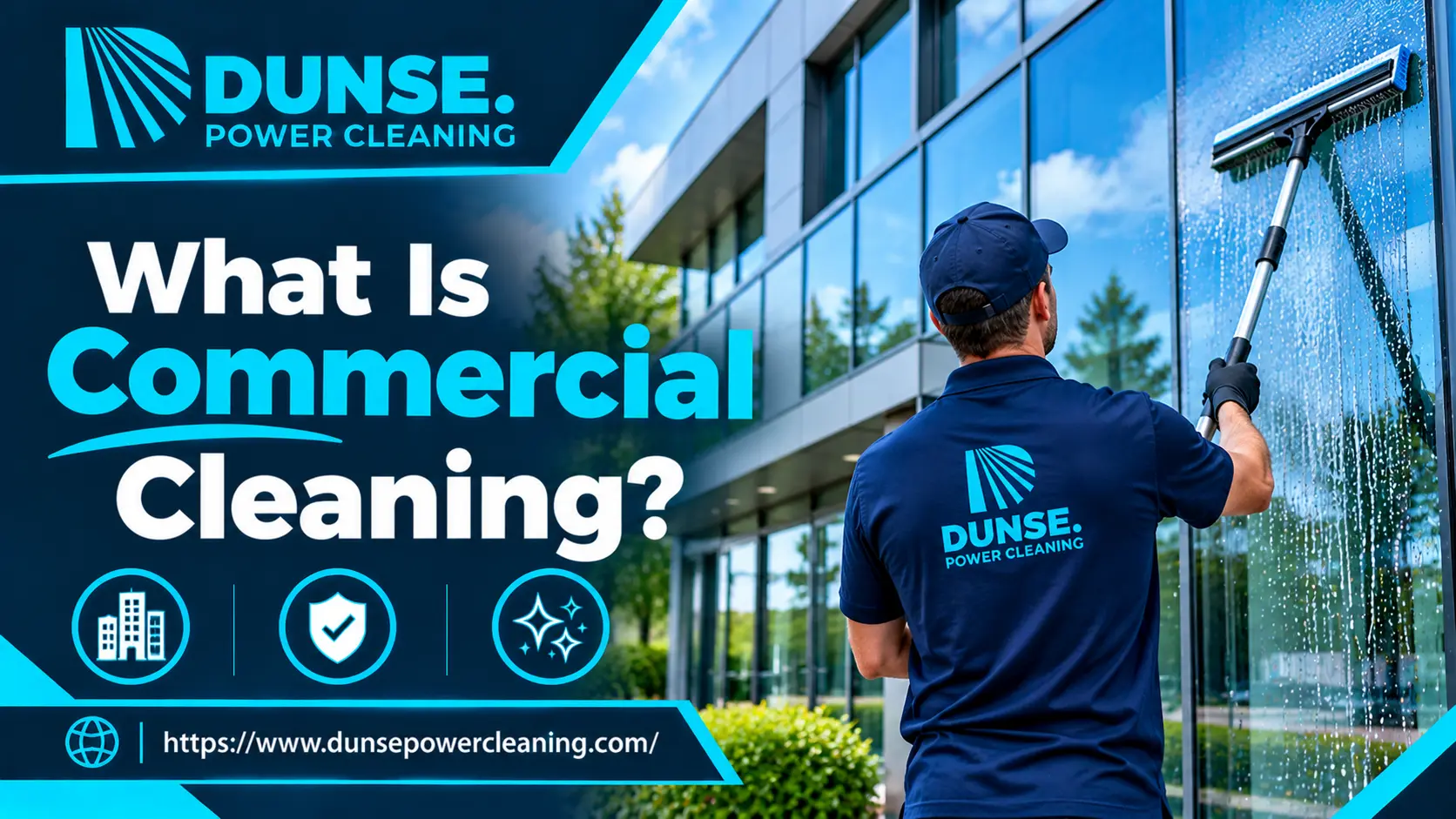
What Is Commercial Cleaning? Meaning, Types and UK Rules
Edinburgh · Commercial Cleaning Guide
Ask five businesses what commercial cleaning means and you get five answers. An office thinks of bins and carpets. A warehouse thinks of floors. A shop owner thinks of the frontage. Here is the plain definition, what it covers and how to choose well.
What this guide covers
- What is commercial cleaning? A plain-English definition
- Commercial cleaning vs domestic cleaning
- Types of commercial cleaning: inside and outside
- What does a commercial cleaning contract include?
- UK rules that shape commercial cleaning
- How to choose a commercial cleaner
- Commercial cleaning Scotland: Edinburgh, Livingston, East Calder and Bathgate
- Why trust Dunse Power Cleaning: our experience
- Frequently Asked Questions
Key Takeaways
- What is commercial cleaning? It is professional cleaning of business and other non-residential buildings.
- It covers daily upkeep, deep cleans and specialist work, both inside and outside.
- Most guides skip the outside of buildings, such as cladding, brickwork, roofs and gutters.
- UK law expects cleaners to control chemical risks, and clients should ask what a contractor brings on site.
- Agree the scope, schedule and access in writing before any work starts.
The phrase sounds simple, yet it means different things to different people. Search for it and you find pages written for the US, full of janitorial lists and square-foot prices. Few explain how it works for a business in Edinburgh.
This guide answers what is commercial cleaning in plain terms, and shows what the answer means for a business in Edinburgh. It covers the definition, the main types, the rules that apply in the UK and how to choose a contractor. If you want a quote for your own premises, you can contact our team at any point.
What is commercial cleaning? A plain-English definition
Commercial cleaning is professional cleaning of business and other non-residential buildings, such as offices, shops, warehouses, schools and industrial units. It covers regular upkeep, periodic deep cleans and specialist jobs, inside and outside. A trained team works to an agreed schedule and specification.
Commercial cleaning meaning: what the term covers
The commercial cleaning meaning depends on the building, but the idea stays the same. It is cleaning designed around a business, not a home. People also ask what does commercial cleaning mean in practice. It means a contract, a plan and a standard, not just a one-off visit.
You will see several names for similar work. Janitorial is an American term for daily upkeep. In the UK, firms say contract cleaning or office cleaning. The commercial cleaning definition that includes all of these is the broadest one.
What is a commercial cleaner?
A commercial cleaner is a person or company that cleans business premises for a fee. Some specialise in interiors, such as offices and floors. Others, like us, specialise in exteriors, such as cladding, brickwork, roofs and gutters. Always ask which one you are hiring.
Commercial cleaning vs domestic cleaning
So what is commercial cleaning compared with the domestic kind? The main differences are scale, schedule, equipment and rules. Commercial jobs cover larger spaces and run to contracts, while domestic jobs cover homes and often run as one-off visits. Businesses also need cleaners who follow workplace safety law.
| Commercial cleaning | Domestic cleaning | |
|---|---|---|
| Premises | Offices, shops, warehouses, schools, industrial units | Houses and flats |
| Schedule | Daily, weekly or contract-based | Often one-off or weekly |
| Equipment | Machines, access equipment, specialist products | Household tools and products |
| Rules | Workplace health and safety law applies | Fewer formal requirements |
| Paperwork | Specification, risk assessment, insurance | Often informal |
Types of commercial cleaning: inside and outside
Commercial cleaning splits into interior and exterior work. Interior work covers daily upkeep, floors, carpets, washrooms and windows. Exterior work covers cladding, brickwork, roofs, gutters, car parks and graffiti. Most pages online cover only the first half, and that is the gap this guide fills.
The main types of commercial cleaning
Every building needs a different mix
Daily upkeep
Bins, washrooms, floors and common areas, on a regular schedule.
Deep and specialist cleans
Carpets, floor care and sanitising for healthcare, food or education sites.
Cladding and brickwork
Algae, traffic film and staining removed from building frontages.
Roofs and gutters
Moss, debris and blocked gutters on commercial and industrial roofs.
Hard surfaces and graffiti
Car parks, paths, shutters and graffiti removed from walls.
Planned maintenance
Regular visits that stop heavy build-up and keep a smart frontage.
Our own commercial work focuses on the outside of buildings. See our pages on cladding cleaning, brick and render cleaning, graffiti removal, roof cleaning and gutter cleaning. Our guide to roof cleaning in Edinburgh shows how we approach one of these in detail.
What does a commercial cleaning contract include?
A good contract names the premises, the tasks, the schedule, the standards and the access arrangements. It also states who supplies equipment and products, and what happens if work falls short. Clear written terms stop arguments later.
How a commercial cleaning job should run
Four stages, whatever the building
Ask for the specification, not just a price. Two quotes only compare fairly when they describe the same tasks, products and access.
UK rules that shape commercial cleaning
UK law expects employers and contractors to control the risks of cleaning work. The main rules cover hazardous substances (COSHH) and work at height. Competent firms assess the risks, train their staff and tell clients what they are bringing on site.
HSE explains that a COSHH assessment covers cleaning products, and that contractors need to know the risks, and you need to know what hazardous substances they bring. The same duty runs both ways. Ask for the risk assessment, and expect to share your own site hazards.
For exterior work, access matters. HSE says mobile platforms must be properly selected, managed and operated by trained people. We offer cherry picker hire for upper floors and tall frontages.
Accepting a low quote with no risk assessment, method or proof of insurance. If something goes wrong on your premises, you share the problem.
How to choose a commercial cleaner
Choose a cleaner who surveys first, writes down the scope and can show how they train and protect staff. The British Institute of Cleaning Science, a UK standards and training body, provides accredited training and best practice for the cleaning industry, so ask whether staff hold recognised training.
- Do you survey the building before quoting?
- What exactly does the specification include and exclude?
- Can you show proof of public liability insurance?
- Do you carry out risk assessments, and can I see them?
- Which chemicals and equipment will you bring on site?
- How is your staff trained and supervised?
- Can I read independent reviews, for example on Checkatrade?
Frequency also matters. Interiors need daily or weekly attention. For exteriors, SPS Exterior Cleaning suggests cleaning cladding every 12 to 24 months, with more frequent visits in damp or shaded spots.
Commercial cleaning Scotland: Edinburgh, Livingston, East Calder and Bathgate
Edinburgh’s damp climate, traffic film and tall buildings shape exterior cleaning. West Lothian’s industrial units and newer estates collect algae on shaded walls and roofs. We cover commercial cleaning Scotland across Edinburgh, Glasgow and the central belt.
See our local pages for Edinburgh, Livingston, East Calder and Bathgate.
Why trust Dunse Power Cleaning: our experience
If you are asking what is commercial cleaning for your own premises, we start with a survey. We are a Livingston-based exterior cleaning business. Alasdair and the team clean cladding, roofs, gutters and masonry across Edinburgh, Glasgow and West Lothian. Our commercial cleaning page describes tailored cleaning plans for each business, and we are a member of Checkatrade, where you can read verified reviews.
This guide draws on HSE’s COSHH and mobile platform guidance, BICSc and SPS Exterior Cleaning, all linked so you can check them. We assess your building first, choose a method that suits the surface and tell you when a job needs a repair, not a clean.
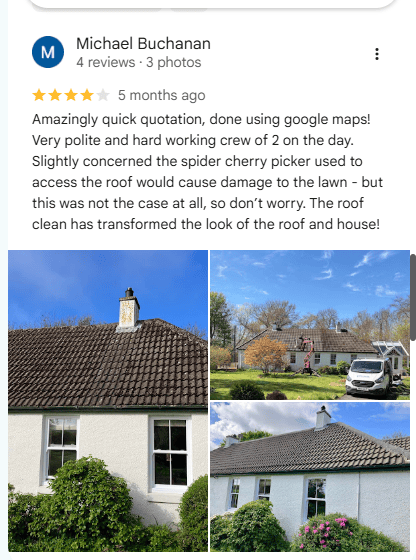
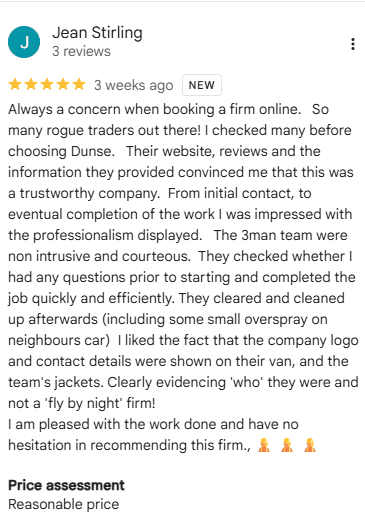
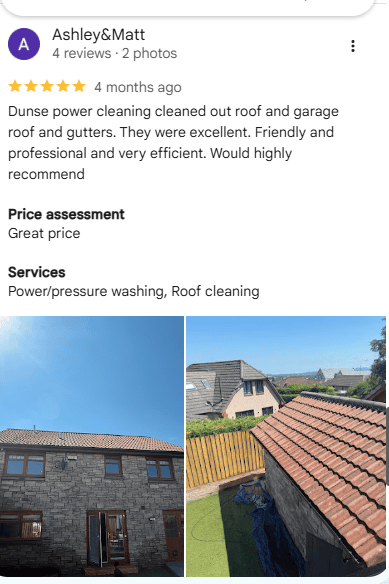
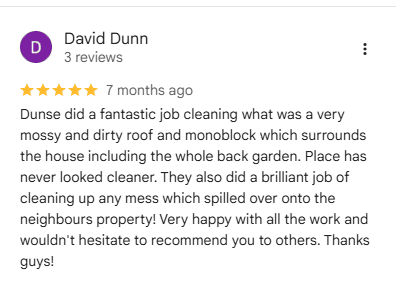
Customer reviews
What our customers say
Frequently Asked Questions
What is commercial cleaning in simple terms?
Commercial cleaning means professional cleaning of business and other non-residential buildings, such as offices, shops, warehouses, schools and industrial units. It covers regular upkeep, periodic deep cleans and specialist work, inside and outside. Unlike home cleaning, it works to schedules, specifications and safety rules that suit the building and its use.
What is the difference between commercial cleaning and janitorial services?
Janitorial is mainly an American term for routine daily upkeep, such as bins, toilets and floors. Commercial cleaning is the wider umbrella. It includes that daily work plus deep cleans, floor care, window cleaning and exterior cleaning. In the UK, you will also hear contract cleaning or office cleaning for similar services.
Does commercial cleaning include the outside of buildings?
Yes. Many guides only cover interiors, but commercial cleaning also includes cladding, brickwork, roofs, gutters, car parks, graffiti and hard surfaces. Exterior work needs different skills, such as safe access at height and low-pressure or soft washing methods. Ask any contractor which areas their service covers.
How often should commercial premises be cleaned?
It depends on use. Offices and shops usually need daily or weekly interior cleaning. Exteriors need less. One UK firm suggests cleaning cladding every 12 to 24 months, with more frequent visits for busy roads, shaded walls and damp sites. Agree a schedule in writing so both sides know what to expect.
How do I choose a commercial cleaner?
Choose a cleaner who surveys your building first and agrees a written scope. Ask about staff training, proof of insurance, risk assessments and the chemicals they bring on site. HSE says contractors must tell you what risks they bring. Compare quotes for the same specification, and read independent reviews before you sign.
Need a commercial cleaner you can rely on?
Tell us about your premises and we will arrange a free quote. We cover Edinburgh, Livingston, East Calder, Bathgate and the surrounding area.
Get your free commercial cleaning quote →