

How to Clean Rendered Walls| Safe Fixes for Green Streaks
Edinburgh · Render Cleaning Guide
Green streaks on your render are more than ugly. They show the wall stays damp. Clean it the wrong way and you strip the finish or push water inside. Here is how to clean rendered walls safely, and what changes for Scottish harling.
What this guide covers
- How to clean rendered walls: the safe method, step by step
- What is staining your render?
- Which render do you have? Method by type
- Historic lime harl: why Scottish walls need extra care
- Cleaning rendered walls yourself: what is safe
- How much does render cleaning cost?
- How to keep render clean for longer
- Render cleaning in Edinburgh, Livingston, East Calder and Bathgate
- Why trust Dunse Power Cleaning: our experience
- Frequently Asked Questions
Key Takeaways
- Soft washing with a render-safe treatment is the safest method for most rendered walls.
- Pressure washing is unsuitable for dry dash and pebbledash. Even on smooth render, high pressure can strip coatings.
- Old lime harl needs specialist advice. Historic Environment Scotland warns that biocides may damage masonry.
- UK guides put render cleaning at £6 to £12 per square metre, with a re-clean every two to four years.
- Clean from the ground only. Never use a ladder and a pressure washer together.
Render looks smart for years, then the north-facing wall turns green. Black spots appear under the gutters. Red-brown streaks spread along the shaded side. Most owners reach for a pressure washer, and that is often the first mistake.
This guide explains how to clean rendered walls step by step. It covers the stains, the methods that suit each render type and what manufacturers say. It also covers a Scottish gap: old lime harling and dry dash finishes. If you want a pro to look at your walls, you can contact our team for a free quote.
How to clean rendered walls: the safe method, step by step
To clean rendered walls safely, check the render for cracks, protect plants and openings, apply a render-safe treatment or mild detergent, let it work, then rinse at low pressure from top to bottom. Gentle methods protect coatings and slow regrowth better than high-pressure jets.
Softwash render cleaning: how it works
Softwash render cleaning uses low pressure and a treatment that kills algae at the source. MyJobQuote explains that it starts with an inspection and a porosity test, and that cracks should be repaired first so water does not enter the wall. The treatment then sits for 15 to 60 minutes before a low-pressure rinse.
The four stages of a soft wash
Based on MyJobQuote’s description of the process
What is staining your render?
Most marks on render are algae, mould or lichen. Damp, shade and pollution feed them. MyJobQuote notes that walls that are shaded, north-facing or near busy roads stain first. Knowing the mark helps you choose the fix. That matters before cleaning render, because each mark needs a slightly different treatment.
Four common marks on render
A quick guide to what you are looking at
Green algae
Soft green film, often on shaded walls. The easiest to treat.
Black mould or lichen
Dark spots or crusty patches. May need a second treatment.
Red or orange algae
Rust-like streaks, common in damp and coastal areas. Stubborn.
White powdery marks
Often salts, not growth. Cleaning does not fix the damp behind them.
Which render do you have? Method by type
The right method to clean render depends on the finish. Thin-coat renders such as monocouche, K Rend, silicone and acrylic suit soft washing. Dry dash, pebbledash and roughcast need extra care, and old lime render needs the gentlest approach. Check your finish before you start.
| Render type | Usual method | Avoid |
|---|---|---|
| Monocouche, K Rend, silicone, acrylic | Soft wash with a render-safe treatment | High-pressure jets |
| Dry dash and pebbledash | Low-pressure soft wash | Pressure washing |
| Painted render | Mild detergent, low pressure | Anything that lifts paint |
| Old lime render or harl | Soft brush, steam, specialist advice | Strong chemicals, pressure |
Weber, a leading render maker, notes that pressure washing is unsuitable for dry dash finishes. Dry dash is common on Scottish homes, which is why this matters here.
Historic lime harl: why Scottish walls need extra care
Old Scottish buildings often carry lime harl. Algae and lichen can produce acids that attack lime render, according to MyJobQuote, so cleaning matters. But harsh cleaning does more harm. Historic Environment Scotland says biocide is unlikely to have a long-lasting effect and may damage masonry.
HES also says cleaning masonry purely for looks is not advised, and that any cleaning needs an agreed method statement and sample test panels. For a listed or traditional building, ask a specialist first and check with your council. This is general guidance, not legal advice.
Treating old lime harl like modern render. Strong chemicals and high pressure can wash out the lime and leave the wall damper than before.
Cleaning rendered walls yourself: what is safe
Cleaning rendered walls yourself is fine for small, reachable patches. If you want to know how to clean rendered walls without a pressure washer, start from the ground with a soft brush and mild detergent. Weber advises removing moss and greenery gently with a brush, then treating the whole wall with a render cleaner. Read the label, and see HSE’s advice on using biocides safely.
Do not climb to reach upper walls. The Ladder Association, working with HSE, advises limiting ladder tasks to short, low-risk jobs. For two storeys, hire a pro. We also offer cherry picker hire for access.
Test any product on a small, hidden patch first. If the colour changes or the surface goes powdery, stop and ask the render maker or a professional.
How much does render cleaning cost?
Render cleaning costs about £6 to £12 per square metre in the UK, according to MyJobQuote’s August 2026 guide. Access, render type and the level of staining change the price. A typical job takes one to two days.
| Property | Typical range | Average |
|---|---|---|
| Terraced house | £420 to £1,080 | £760 |
| Semi-detached house | £600 to £1,680 | £1,140 |
| Detached house | £720 to £1,800 | £1,260 |
Source: MyJobQuote, 5 August 2026. Guide prices, not Dunse prices.
Extras add up. MyJobQuote lists £200 to £300 for minor render repairs, about £20 per square metre for a protective coating and scaffolding from £600 for full exterior cover. Repainting the exterior can cost £1,500 to £7,700, so cleaning is often the cheaper refresh.
How to keep render clean for longer
Learning how to clean rendered walls is half the job. Keeping them clean is the other half. Render usually needs cleaning every two to four years, and sooner on shaded or rainy walls. Weber suggests washing once a year or as needed. You can stretch the gap with a few habits.
- Keep gutters and downpipes clear, so water does not streak the wall. Our gutter cleaning service helps here.
- Trim plants and branches away from the wall.
- Repair cracks early, before water gets in.
- Ask about a protective coating, which MyJobQuote says can reduce how often you clean.
- Treat early. Light algae clears easily, and heavy growth takes more work.
Our guide on the roof cleaning pressure washer explains the same pressure risks for tiles, and our soft cleaning service covers gentle exterior washing.
Render cleaning in Edinburgh, Livingston, East Calder and Bathgate
Edinburgh’s damp climate and shaded closes feed algae on render. West Lothian’s newer estates mix K Rend, monocouche and dry dash, and each needs the right method. We cover the whole area. See our pages for Edinburgh, Livingston, East Calder and Bathgate, or ask for a render soft wash quote. Wondering how to clean a rendered wall that sits in deep shade? Ask us.
Why trust Dunse Power Cleaning: our experience
We are a Livingston-based exterior cleaning business. Alasdair and the team clean render, brick, roofs and gutters across Edinburgh, Glasgow and West Lothian. Our brick and render page describes a deep clean using high-temperature washing and biodegradable chemicals chosen for your material. We are a member of Checkatrade, where you can read verified reviews.
This guide draws on Weber, MyJobQuote, Historic Environment Scotland, HSE and the Ladder Association, all linked so you can check them. We assess your render first and tell you when a wall needs a repair, or a specialist, before a clean.
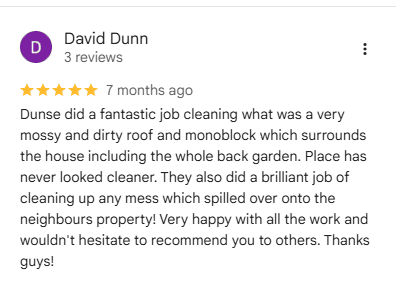
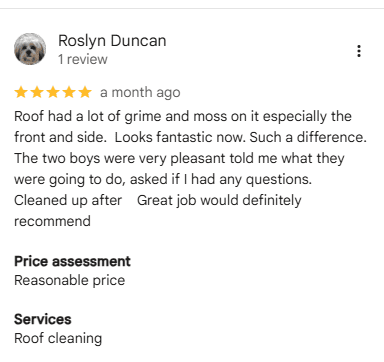
Customer reviews
What our customers say


Frequently Asked Questions
Can you pressure wash rendered walls?
Only with great care, and not on every render. Weber says a pressure washer on a fan setting with mild detergent can suit its coloured render, but pressure washing is unsuitable for dry dash finishes. MyJobQuote advises against it generally, because it can strip coatings. Soft washing is the safer choice for most render.
What is the best way to remove green algae from render?
Remove loose growth gently with a soft brush, then treat the wall with a render-safe biocide or mild detergent and rinse at low pressure. Weber suggests treating the whole wall, not just the green patches. A treatment kills spores, so growth returns more slowly than after plain washing.
How often should render be cleaned?
MyJobQuote says render typically needs cleaning every two to four years, and every two to three years on shaded, north-facing or rainy walls. Weber suggests washing once a year or as often as needed. Porous finishes and walls beside busy roads need more frequent cleans. A protective coating can stretch the gap.
How much does render cleaning cost?
MyJobQuote puts render cleaning at £6 to £12 per square metre. That gives about £760 for a terraced house, £1,140 for a semi and £1,260 for a detached house on average. Access, render type and staining level change the price. A free quote based on your own walls gives the real figure.
Can you clean pebbledash or harling?
Yes, but not with a pressure washer. Weber says pressure washing is unsuitable for dry dash finishes, which are common in Scotland. A low-pressure soft wash with a suitable treatment is safer. For old lime harl on a historic building, take specialist advice first, because the wrong method can cause lasting damage.
Want your render looking fresh again?
Tell us about your walls and we will arrange a free quote. We cover Edinburgh, Livingston, East Calder, Bathgate and the surrounding area.
Get your free render cleaning quote →