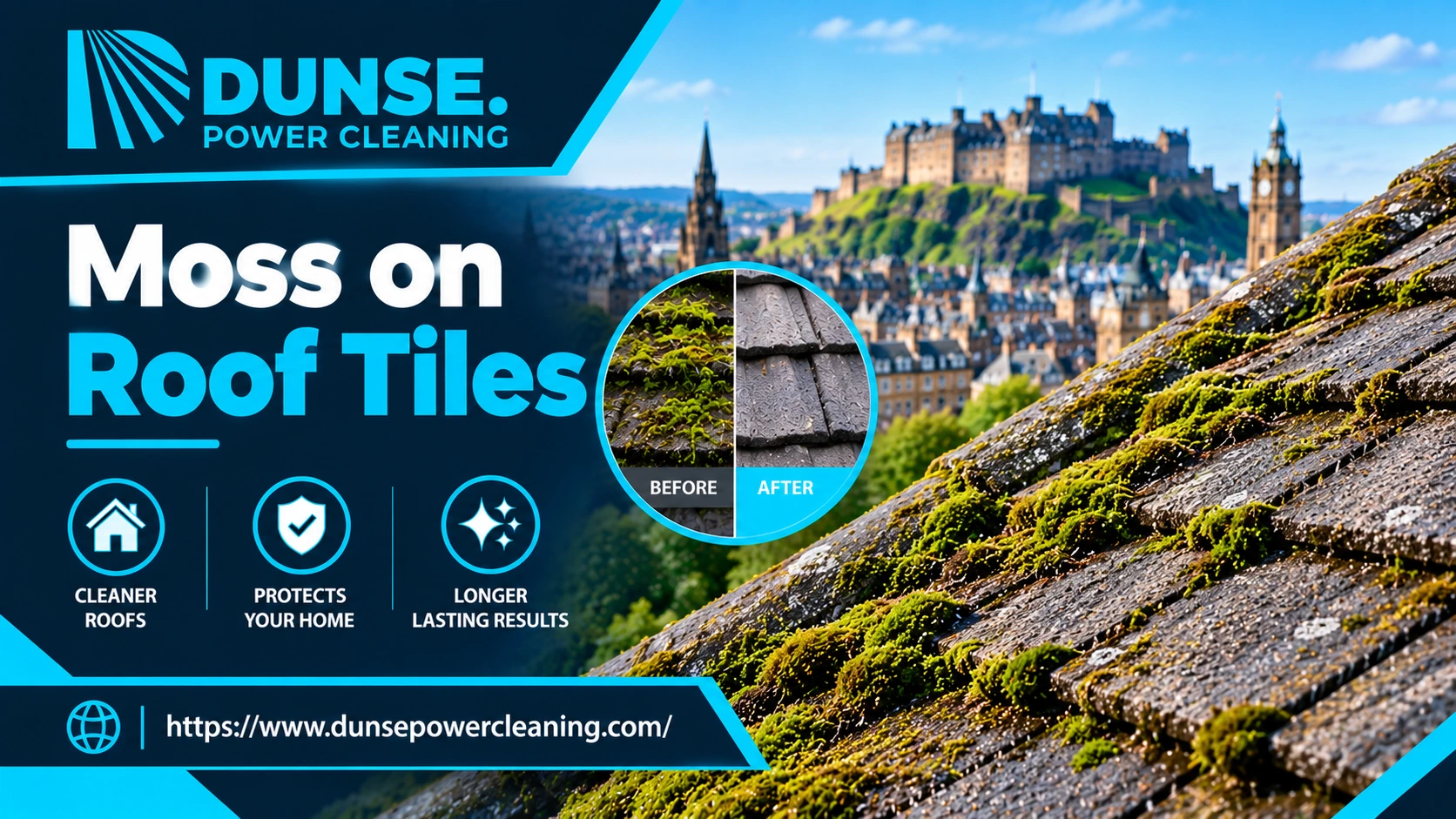
Moss on Roof Tiles in Edinburgh | Harmless Green Fuzz or a Damage Warning? How to Tell
Edinburgh · Roof Moss Guide
Green fuzz on your tiles is not always a disaster, and not always harmless either. Experts disagree on how bad it is. This guide cuts through the noise and tells you when to act and when to wait.
What this guide covers
- Moss on roof tiles: is it really a problem?
- Does moss damage roof tiles? What it can and cannot do
- What causes moss on roof tiles?
- Is it okay to leave moss on roof tiles?
- What to do if moss is growing on your roof tiles
- How much does it cost to remove moss from a roof in the UK?
- Can you remove moss from roof tiles yourself?
- How to keep moss off your roof tiles
- Moss on roof tiles in Edinburgh, Livingston, East Calder and Bathgate
- Why trust Dunse Power Cleaning: our experience
- Frequently Asked Questions
Key Takeaways
- Light moss on a sound roof is often harmless. Thick, long-standing moss can hold water, block drainage and hide damage.
- Moss grows where dirt, shade and damp meet, so north-facing slopes and roofs under trees grow it first.
- Act when moss drops into gutters, blocks drainage or sits on an older roof.
- Remove it by hand and treat what remains. Tile makers and NFRC warn against pressure washing.
- Check from the ground. Never climb on the roof yourself.
Look at the roofs on your street. Some are clean. Some are patched with green. Others look like small lawns. Moss on roof tiles is one of the most common sights in Scotland, and one of the most argued about.
Some roofers say moss destroys roofs. Others say leave it alone. Both sides have a point. The truth sits in the middle, and it depends on your roof, your tiles and how much moss you have.
This guide explains how moss on roof tiles behaves, what experts actually say, what causes it, when to remove it and what a fair job costs. If you want someone to look at your roof, you can contact our team for a free quote.
Moss on roof tiles: is it really a problem?
Moss on roof tiles is a problem when it is thick, long-standing or blocking drainage. A thin layer on a sound roof usually does little harm. Heavy growth holds water against the tiles, can clog gutters and can hide cracked or slipped tiles from view.
Think of moss as a warning light, not an emergency. It tells you your roof stays damp. What you do next depends on how much growth you have and what is going on underneath.
Is moss on roof bad or harmful? What the experts say
Experts do not fully agree, and that is worth knowing. Marley, a major UK tile maker, states that in normal circumstances moss and lichen are not harmful to tiles or slates. It adds that extreme growth can affect drainage and should then be removed.
Wienerberger, another large tile maker, takes a firmer line. It says that if you leave growth for long periods, moss can keep tiles damp, can block tile interlocks and can damage ridge mortar and clay tile surfaces.
So is moss on roof bad for your home? Our reading is simple. Light growth is rarely urgent, and heavy growth deserves action. People also ask is moss on roof harmful to health. Moss itself does not harm people, but the slippery surface makes working on a mossy roof dangerous.
Light moss or heavy moss: how worried should you be?
A quick guide for what you can see from the ground
Light and patchy
Thin growth in a few spots. Usually fine to watch.
Thick and spreading
Dense mats over large areas. Plan a clean soon.
In the gutters
Clumps falling into gutters or downpipes. Act now.
Near damage
Moss around slipped, cracked or loose tiles. Get it checked.
Does moss damage roof tiles? What it can and cannot do
Moss can damage roof tiles over time, but it rarely does so quickly. It acts mainly by holding water. Constant dampness then causes secondary problems such as clay tile delamination, blocked interlocks, cracked ridge mortar and overflowing gutters. Understanding each one helps you judge your own roof.
Here is what the evidence says about does moss damage roof tiles, one problem at a time.
It holds water against the tile
NFRC, the roofing trade body, explains that the primary effect of moss is that it holds water. Rain runs off more slowly, and water stays in contact with the tiling for much longer. Everything else follows from that.
It can harm clay tiles and ridge mortar
Wienerberger notes that damp clay tiles are more prone to delamination, where the surface separates from the tile body. It also says moss thrives on mortar and can crack it around ridge tiles. Thick moss can even add weight from the water it holds.
It can block interlocks and gutters
Moss that grows in tile joints can block the channels that carry water away. Clumps that fall off also clog gutters and downpipes. Overflowing water then soaks the wall below, which creates a second problem you did not expect.
It can hide existing damage
This one gets overlooked. A thick carpet of moss can cover cracked tiles, slipped tiles and failing mortar. Cleaning the roof does not repair those faults, but it lets you see them. That is why a careful cleaner looks for damage as well as moss.
What causes moss on roof tiles?
Moss grows on roof tiles when dirt, shade and damp combine. A rough tile surface traps dirt from rainwater, and spores blow in and take root. Trees, north-facing slopes, low pitches and damp winters all speed things up. Knowing what causes moss on roof surfaces helps you slow it down.
Six things that cause moss on roof tiles
Most mossy roofs have two or three of these at once
Rough tile surface
Sanded and granule faces filter dirt out of rain (NFRC).
Nearby trees
Leaves, seeds and shade create ideal growing conditions.
Low pitch
Shallow roofs shed water slowly and stay damp longer.
North-facing slopes
Less sun means longer drying times after rain.
Damp winters
Wet, mild weather suits moss. Winter growth is common.
Debris build-up
Leaves, dust and nesting material feed spores.
Why one side of your roof grows more moss
NFRC notes that north-facing slopes stay damp longer and attract more growth, while steeper roofs shed water faster and grow less. That is why one slope of your roof can turn green while the other stays clean. Wienerberger adds that heavy moss at the ridge may also point to poor ventilation in the roof space.
Is it okay to leave moss on roof tiles?
It is sometimes okay to leave moss on roof tiles, but not forever. Light growth on a sound, well-drained roof can wait while you monitor it. Thick moss, moss dropping into gutters, and moss on an older roof should be dealt with sooner rather than later.
Many pages online push you to clean immediately. Others tell you to ignore it. A fair approach checks your own roof against a short list.
| What you see | Leave it or act? | Why |
|---|---|---|
| Thin, patchy moss on a sound roof | Usually leave and monitor | Little effect on drainage. |
| Thick mats across large areas | Act within the year | Holds water and adds weight. |
| Moss clumps in gutters | Act soon | Blocked gutters soak walls and tiles. |
| Moss at the ridge with cracked mortar | Get it checked | Moss grows into mortar and widens cracks. |
| Moss around slipped or cracked tiles | Act and repair | Moss may be hiding faults. |
| Older roof you want to protect | Plan a clean | Constant damp shortens the life of tiles. |
A moss roof that is also leaking inside needs a roofer first. Cleaning treats the growth, not the leak. Get the cause checked before you spend on cosmetics.
What to do if moss is growing on your roof tiles
If you spot moss on your roof tiles, look at it from the ground, take photos, check the gutters and decide whether it needs action. Do not climb on the roof. If the growth is heavy or you notice damage, ask a professional for a written quote. Mossy roof tiles are slippery and fragile.
Four steps when you find moss
All of them can be done safely from the ground
What removes moss from roof tiles?
Hand removal followed by a treatment made for roofs removes moss best. A brush or trowel clears the bulk on a dry day. The treatment then kills what remains, and rain washes the dead growth away. Wienerberger advises this on a dry day, when moss is less moist and lifts more easily.
Our own method mixes techniques. We use customised approaches such as pressure washing and scraping where your roof can take them, and we finish with a soft wash treatment. Our guide to soft washing versus power washing explains the difference, and our article on roof tile cleaning covers tile care in more detail.
What not to do
- Do not pressure wash. NFRC says it can force water into the roof space. Marley says jet washes can damage tile and slate surfaces. Wienerberger adds that if a low-pressure wash is used, it should run from the apex downward, never upward.
- Do not walk on the tiles. Wienerberger warns that tiles may develop hairline cracks you cannot see, which grow in frost.
- Do not paint the roof. NFRC notes that surface treatments applied after cleaning may invalidate a tile maker’s guarantee, and Wienerberger generally advises against painting tiles.
- Do not use random chemicals. NFRC warns that chemical washes can harm plants and animals and must not reach watercourses. Use products made for roofs and follow the label.
Scrubbing mossy tiles with a stiff brush from a ladder. It damages the tile surface, leaves spores behind and puts you at risk of a fall.
How much does it cost to remove moss from a roof in the UK?
Hand removal with a treatment costs about £8 to £15 per square metre in the UK, according to Checkatrade’s April 2026 guide. For an average-sized roof that usually means roughly £600 to £1,125. Access, gutters and repairs can change the final bill.
| Roof size | Hand removal and treatment |
|---|---|
| Small roof (about 65 m²) | £520 to £975 (average £747.50) |
| Average roof (about 75 m²) | £600 to £1,125 (average £862.50) |
| Large roof (about 85 m²) | £680 to £1,275 (average £977.50) |
Source: Checkatrade roof cleaning cost guide, updated April 2026. UK guide prices, not Dunse quotes.
Costs rise with steep pitches, tall buildings, thick moss and awkward access. Scaffolding or other safe access is often priced separately, so ask what the quote includes. The fairest way to get a real number is a free quote based on your own roof.
Can you remove moss from roof tiles yourself?
You can inspect from the ground, but you should not climb up to remove moss. The Health and Safety Executive states that almost one in five deaths in construction work involve roof work, and many are people repairing and cleaning roofs. Mossy tiles are slippery, and tiles themselves can crack underfoot.
Both Marley and Wienerberger suggest speaking to a professional before starting. Professionals use proper access equipment, such as crawling boards, that spread weight across the roof. That protects both the tiles and the person on them.
How to keep moss off your roof tiles
You cannot stop moss entirely, but you can slow it. Check your roof every year, clear gutters, trim nearby branches and add copper strips if growth keeps returning. Wienerberger suggests an annual visual inspection and maintenance access every three to five years, sooner for shaded or damp roofs.
- Trim branches that shade the roof or drop leaves onto it.
- Keep gutters and valleys clear. Our gutter cleaning service pairs well with a roof clean.
- Ask a roofer about copper strips fixed near the ridge, which release ions that discourage growth below them.
- Repair slipped or cracked tiles so water cannot pool.
- Book a light follow-up treatment before growth takes hold again.
Moss on roof tiles in Edinburgh, Livingston, East Calder and Bathgate
Scottish weather gives moss an easy ride. Mild, damp conditions and shaded streets suit it, and many roofs never dry fully in winter. The result is that moss on roof tiles shows up all over Edinburgh and West Lothian, and the advice above applies to all of it.
Edinburgh
Edinburgh mixes tenements, villas and modern estates. Older slate roofs need a gentle hand, and tall buildings may need extra access. Our page on roof cleaning in Edinburgh gives local detail.
Livingston, East Calder and Bathgate
West Lothian has many newer estates with concrete tiles, whose rough faces attract moss early. Homes near woods and fields collect leaves and spores faster. We have local pages for Livingston, East Calder and Bathgate.
Why trust Dunse Power Cleaning: our experience
We are a local exterior cleaning business based in Livingston. Alasdair and the team clean roofs, clear gutters and remove moss across Edinburgh, Glasgow and West Lothian. We look at every roof first and choose the method that suits it.
Where the guidance in this article comes from
The advice here draws on NFRC’s guidance note on moss, the tile makers Marley and Wienerberger, HSE’s roof work guidance and Checkatrade’s cost guide. We linked each so you can check the source yourself. Because tile makers do not fully agree on how harmful moss is, we show both views and give our own balanced reading.
What customers say about our work
Customers describe the same things. One homeowner noted a full day of work on a roof thick with moss from nearby woods. Others mention that we moved garden items and put them back, and that we left the site tidy. We are a member of Checkatrade, where you can read verified reviews.
Our honest approach
We tell you when moss is harmless and can wait. We tell you when a method would harm your tiles. We also tell you when your roof needs a roofer instead of a cleaner. Straight advice beats a quick sale every time.
Frequently Asked Questions
Is it okay to leave moss on roof tiles?
Sometimes. Light moss on a sound roof often does little harm, and Marley says growth is not normally harmful to tiles. Act when moss is thick, dropping into gutters, blocking drainage, hiding damaged tiles or sitting on an ageing roof. If you are unsure, get a professional to look and give honest advice.
What removes moss from roof tiles?
Hand removal with a brush or trowel on a dry day clears the bulk. A treatment made for roofs then kills what remains, and rain washes the dead growth away over weeks. Avoid pressure washing, because tile makers and NFRC warn it damages tiles and forces water into the roof space.
How much does it cost to remove moss from a roof in the UK?
Checkatrade’s April 2026 guide puts hand removal with treatment at about £8 to £15 per square metre. For an average-sized roof that usually means roughly £600 to £1,125. Scaffolding, gutter work and repairs can add to that. Your exact price needs a roof inspection, so ask for a free quote.
Does moss damage roof tiles?
It can, but not always quickly. Moss holds water against tiles, and clay tiles in particular can delaminate when kept damp. It can also block tile interlocks, harm ridge mortar and clog gutters. Light growth on a sound roof is less urgent. Heavy, long-standing growth deserves attention.
What should I do if moss is growing on my roof tiles?
Check it from the ground with binoculars and take photos. Look for moss in gutters, slipped tiles and thick patches near the ridge. Do not climb on the roof. If growth is heavy or you spot damage, ask a professional for advice and a written quote before deciding.
How long before moss grows back on roof tiles?
It depends on shade, trees, roof pitch and damp. Wienerberger suggests accessing the roof for maintenance every three to five years, with shorter gaps for shaded or damp roofs. A treatment slows regrowth, and trimming branches and clearing gutters help. No honest cleaner promises a fixed number of years.
Not sure if your moss needs removing?
Tell us about your roof and we will give you honest advice and a free quote. We cover Edinburgh, Livingston, East Calder, Bathgate and the surrounding area.
Get your free moss removal quote →